


Giorgio Tardonato
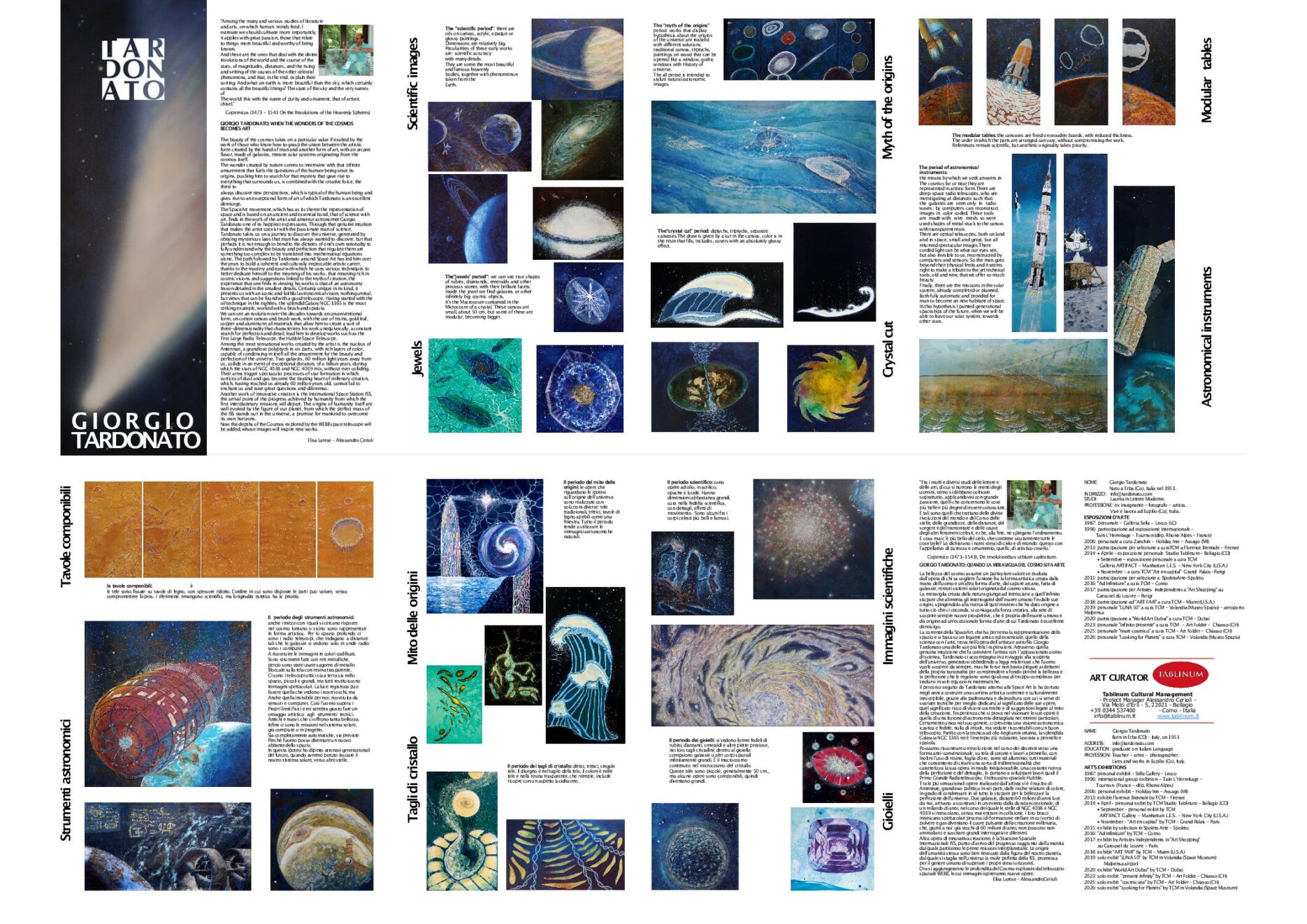
The beauty of the cosmos takes on a particular value if exalted by the work of those who know how to grasp the union between the artistic form created by the hand of man and another form of art, with an arcane flavor, made of galaxies, remote solar systems originating from the cosmos itself. The wonder created by nature comes to intertwine with that infinite amazement that fuels the questions of the human being since its origins, pushing him to search for that mystery that gave rise to everything that surrounds us, it combines with the creative force, the thirst to always discover new perspectives, which is typical of the human being and gives rise to an exceptional form of art of which Tardonato is an excellent demiurge. The current of SpaceArt, which has as its theme the representation of space and is based on an ancient and essential bond, that of science with art, finds in the work of the artist and amateur astronomer Giorgio Tardonato one of its happiest expressions. Through that genuine intuition that makes the artist coexist with the passionate man of science, Tardonato takes us on a journey to discover the universe, generated by obeying mysterious laws that man has always wanted to discover, but that perhaps it is not enough to bend to the dictates of one's own rationality to fully understand why the beauty and perfection that regulate them are something too complex to be translated into mathematical equations alone. The path followed by Tardonato around Space Art has led him over the years to build a coherent and culturally impeccable artistic career, thanks to the mastery and ease with which he uses various techniques to better dedicate himself to the meaning of his works, that meaning rich in cosmic visions and suggestions linked to the myth of creation, the experience that one feels when viewing his works is that of an astronomy lesson detailed in the smallest details. Certainly unique in its genre, it presents us with an iconic and faithful astronomical vision, nothing unreal, but views that can be seen with a good telescope. Having started with the oil technique in the eighties, the splendid Galaxy NGC 1365 is the most striking example, worked with a brush and spatula. We can see an evolution over the decades towards an unconventional form, on cotton canvas and brush work, with the use of resins, gold leaf, copper and aluminum; all materials that allow him to create a sort of three-dimensionality that characterizes his work unequivocally, a constant search for perfection and detail, lead him to develop works such as the First Large Radio Telescope, the Hubble Space Telescope. Among the most sensational works created by the artist is the nucleus of Antennae, a grandiose polyptych in six parts, with rich layers of color, capable of condensing in itself all the amazement for the beauty and perfection of the universe. Two galaxies, 60 million light years away from us, collide in an event of exceptional duration, of a billion years, during which the stars of NGC 4038 and NGC 4039 mix, without ever colliding. Their arms trigger spectacular processes of star formation in which vortices of dust and gas become the beating heart of millenary creation, which, having reached us already 60 million years old, cannot fail to enchant us and raise great questions and dilemmas.
Another work of innovative creation is the International Space Station ISS, the arrival point of the progress achieved by humanity from which the first interplanetary missions will depart. The origins of humanity itself are well evoked by the figure of our planet, from which the perfect mass of the ISS stands out in the universe, a promise for mankind to overcome its own horizons.
Now the depths of the Cosmos explored by the WEBB space telescope will be added, whose images will inspire new works.